


By: Etta Adil
PALONTARAQ.ID – AUTHOR has been to Wajo, several times. Get to know many Wajo people, even worked together and led by Wajo People. Therefore, the authors are familiar with the social and cultural character of To Wajo (peoples of Wajo).
Compared to other Bugis ethnic groups in South Sulawesi, To Wajo has its own outstanding characteristics, namely in terms of business management and property ownership. This is reflected in the old phrase, “Ri werengngi pole ri Dewatae ‘, alebbireng koi ri Luwu, asogireng koi ri Wajo, Awaraniang koi ri Bone, Awatangeng koi ri Gowa”. (Given by Dewata, glory to Luwu, wealth to Wajo, bravery on Bone and power on Gowa).
Wajo people are very economical and soulless migrant (merchant). Their commitment in the business world is based on the principle, “massiji warang-parang temma siji balu-balu”. (sibling in the case of property ownership but not in goods selling), socio-cultural adaptation patterns and economic strategies are based on the concept of “Tallu Cappa” (tip of tongue, tip of badik and tip of genital) which means intelligence, courage and marriage) and the principle of ” silellung sirui “(chasing each other and pulling) as an important capital in building a constructive rivalry in the endeavor.
The habit of wandering (sompe ‘) and fate in the land of people attached to the Wajo so often we find the phrase that says, “Padangkang to Wajo’e” (merchant Wajo people) or “Sugi’to Wajo’e adangkangeng’na napakkapong” (wealthy Wajo people for trade or business).
The depiction of the habit of wandering the Wajo, who at the same time reveals the concept of “maradeka” (independence) for the Wajo people in Lontaraq Sukkuqna Wajo (LSW) as follows:
“Maradeka To WajoE, najajiang alena maradeka, tanaemi ata’, naia tomakketanae maradeka manengngi, ade assamaturusengnami napopuang”.
The meaning is:
“The Wajo peoples are independent, and were born in a state of freedom, only the land became servants, every one of them living on the land of Wajo had the right to freedom, and only the hereditary customs had been agreed upon.
“Naia riasengnge maradeka, laje’ tenriatteangngi, lao maniang, lao manoran, lao alau, lao orai’. Mangnganga tange’na Wajo nassu’ ajenamato mpawai massu’. Mallaja-laja tange’na Wajo nauttama, ajenamato pattamai.”
The meaning is:
“Free is meant to be free to go where he likes, not forbidden to the South, North, East or West. The door of Wajo’s country is wide open, so they can leave Wajo, They are also free to enter Wajo again at their feet. Wajo people should not be forced, if they do not obey or carry out orders that have no legal basis”.
Many of the titles pinned to Wajo peoples, some call it “Bugis Kapitalis”, “Chinese Bugis”, “to sekke”, or “pabbalu”, even often I hear the phrase, “watch nabaluk wekkaduako to WajoE” (keep and beware, lest you be sold twice by Wajo people).
All of these titles and phrases must have been based on the wajo tradesmanship, though not entirely true, these terms and phrases should have a fact alignment derived from the social historical roots of the Wajo. Only unfortunately, not everyone, even many of us who no longer understand the cultural identity. So, how is ‘Wajo Man’ now?
* * *
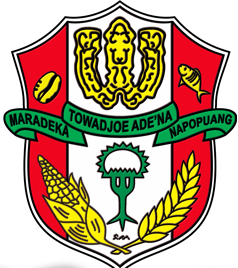
Upon entering Wajo Regency, at the gate we will see the inscription in Bugis lontaraq script reads, “Maradeka to Wajo’e, Ade’na Napopuang”.
This philosophy of independence is also written on the symbol of Wajo Regency. The value of that philosophy is much to equate it with the slogan of the western, born for liberty (born for freedom), the principle of freedom that has long been embraced by the Bugis Wajo.
Meaning is Freedom of Wajo peoples, Only the customs or tradition are made employer, means that people who deserve to be treated as “puang” only people who respect and respect the prevailing customs in society. So even though he is a descendant of nobles, but if he does not appreciate the customs prevailing in society then he does not deserve “dipopuang” (made employer).
The view of many people that Wajo peoples are miserly may need to be straightened out here. In my opinion, stinginess and calculation are two things that are similar but not the same.
The general character of a trader is to be strong in calculation, I do not think there are any traders who want to lose. This is reflected in the nature of Wajo peoples in trade, they do not want to lose even in a minimal amount.
Among them is known the term “Chinese loss”, which is selling something with little profit from previously issued capital. Ade’na napopuang, also means that the Wajo People are only obedient to the rules agreed upon, that includes the philosophy of the merchant.
If associated with the concept of ‘freedom’ then Wajo peoples trade area, very broad, do not want to be limited by region and region boundary. What must be understood here is the cultural message To Wajo from generation to generation related to the entrepreneurial tradition or trading activities, namely “massiji warang-parang temma siji balu-balu”. It means siblings in terms of ownership of property but not in terms of goods sale “.

In this context, To Wajo has realized the importance of the separation between assets related to venture capital that must be exchanged for money and assets unrelated to capital and business activities. That is why, if you ask or borrow something to To Wajo in the market or wherever they sell, then you will get nothing. But if you ask at home, what we ask for will be given.
This is what I like to like from Wajo peoples, let alone the cultural message of ‘keeping’ the trade is still escorted by other messages, “aja numaelo natunai sekke, naburuki labo”. (do not be humiliated by the miserliness and destroyed by the wasteful nature).
The old phrase, “Ri werengngi pole ri Dewatae ‘, alebbireng koi ri Luwu, asogireng koi ri Wajo, Awaraniang koi ri Bone, Awatangeng koi ri Gowa”. (Given by the Gods, the glory of Luwu, wealth to Wajo, Bone’s courage and power to Gowa) basically want to affirm to our generation now that the makassar bugis is one nation, must help each other, support each other and uphold.
What we do not have, there is in others, what is in other regions, is in our area. In essence, the message and the phrase imply the need for cooperation, in terms of mutual support.

Related to Natural Resources (SDA), Wajo is rich with the characteristics of its three dimensional region, “Mangkangulu ri bulue, massulappe dipottanange, mattodang ritapparenge”.
Related to development, of course require local wisdom from Pemkab and Masyarakat Wajo in its management. Of course irony, if Wajo peoples out wander looking for livelihood in the country of people while on the other side Nature sources of Wajo are very rich and abundant. (***)

